

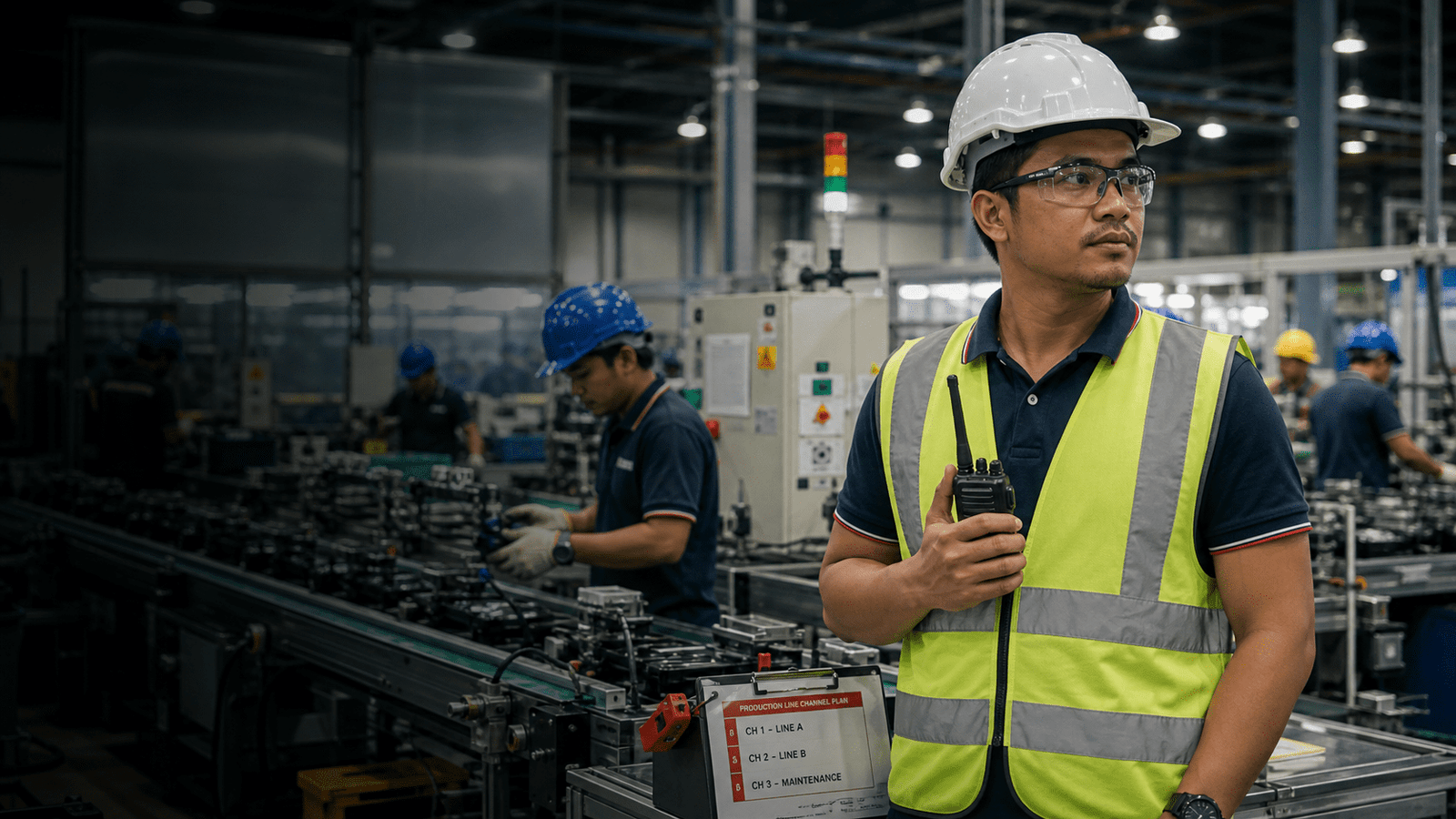
Walkie Talkie for Factory Malaysia: Production Line Guide
A practical production-floor guide for line leaders, maintenance response, safety escalation and shift handover in Malaysian factories.
Can your production line call for help in 3 seconds?
Factories in Shah Alam, Klang, Johor Bahru and Penang often lose output because small line issues wait too long for a supervisor. Dedicated walkie talkie channels give line leaders, maintenance teams and safety officers one shared voice path.
Response index
Measures how quickly production, maintenance and safety teams can coordinate.
Escalation flow
Radio discipline shortens the path between problem, decision and restart.
Channel heatmap
Keep urgent traffic apart from routine production updates.
Line Stop Response: Keep Production Moving
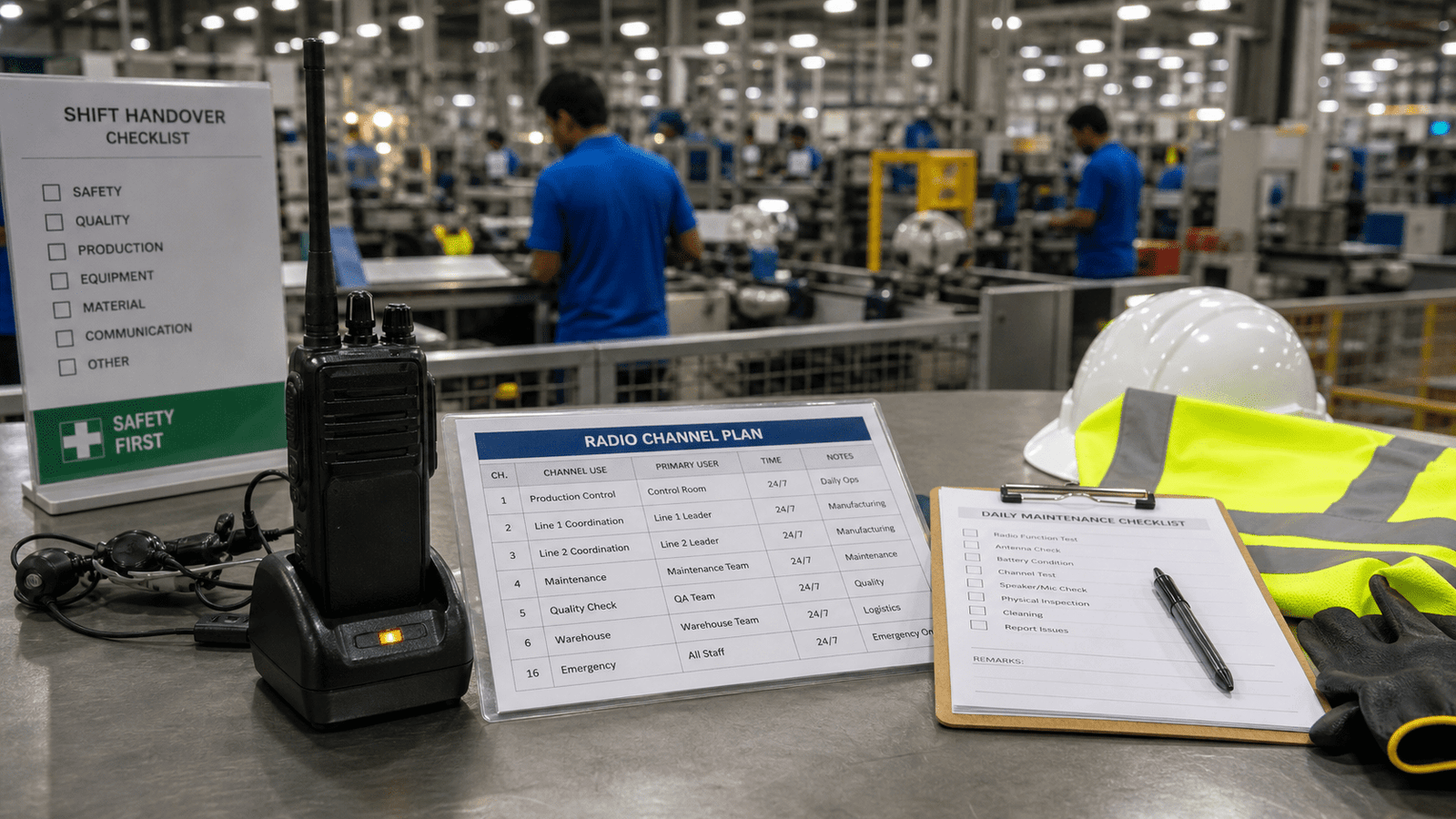
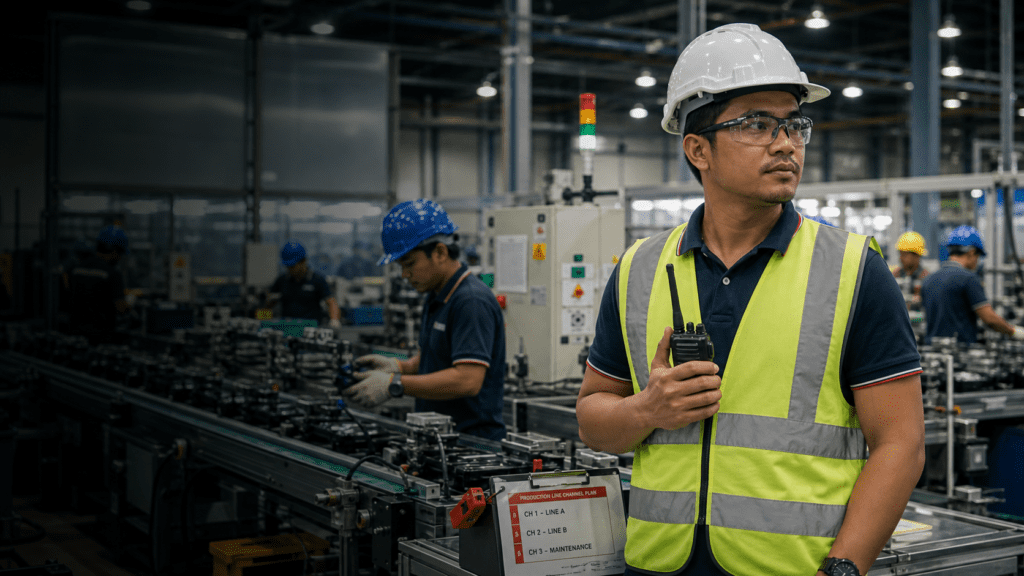
In a Shah Alam packaging factory, a jammed conveyor can stop 26 operators within 90 seconds. If the line leader has to walk to the office or call a mobile phone, the response already feels late. A dedicated walkie talkie channel lets the leader say the exact line, fault and safety condition before leaving the station.
The phrase should be short: ‘Line 3 stop, carton feed jam, maintenance needed, power isolated.’ That one call tells maintenance, production and safety what happened. In our experience, this simple protocol removes most of the shouting and hand waving that happens during the first 2 minutes of a factory breakdown.
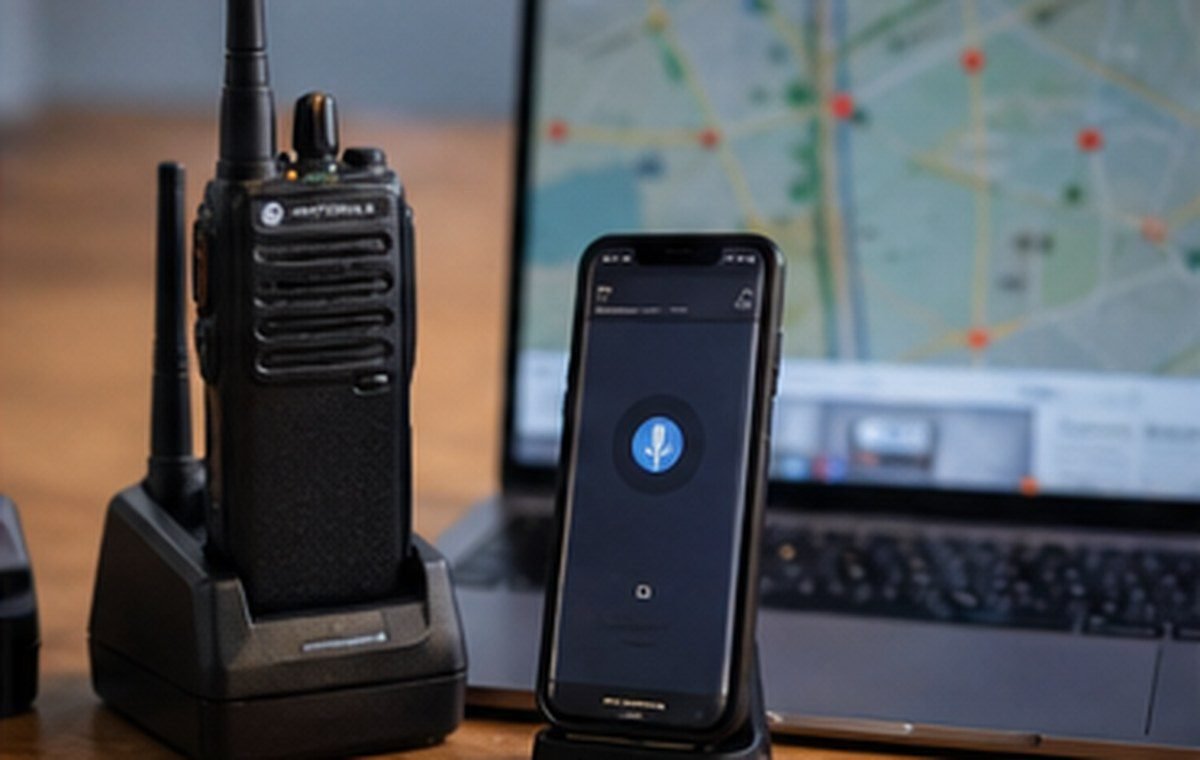
Phones still have a place for photos and documents. They should not be the first alert tool for line stops. A radio stays clipped to the vest, works with gloves and broadcasts to every person who needs the same information.
Maintenance Coordination: Separate Urgent Work from Routine Chatter
A Klang metal fabrication site may have 4 maintenance technicians covering compressors, welding bays, forklifts and one paint booth. If every request lands in the same phone group, urgent repairs compete with routine spare-part questions. Walkie talkie channels let the maintenance lead hear priority calls while operators keep normal production updates somewhere else.
For factories with 80 to 150 staff, Octogen normally recommends at least 6 channels: production, maintenance, quality, warehouse, safety and security. Larger Johor Bahru plants can add repeater coverage for long buildings or heavy concrete walls. The point is not to create more noise. The point is to put each type of noise in the right lane.
Digital radios help when machinery noise is high. Noise suppression, private call and emergency button functions are worth paying for in stamping, injection moulding and fabrication areas where voice clarity can decide whether a machine restarts safely.
Safety Escalation: One Button for the Right People
Factories should treat safety radio traffic as a protected path. A chemical spill in Penang, a forklift near miss in Klang or a burn injury in Johor Bahru needs one channel that people respect. If the safety officer says ‘clear channel’, everyone else should stop.
Emergency-button radios give supervisors an extra layer. A long press can alert the control desk even when a worker cannot explain the situation clearly. This is useful around loading bays, compressor rooms and isolated night-shift areas where a worker may be alone for 15 to 20 minutes.
Radio discipline matters more than radio price. A RM 600 digital unit cannot save a poor protocol. Train staff to use ‘copy’, ‘standby’ and ‘all clear’. Those 3 phrases reduce confusion during drills and real incidents.
Factory Channel Plan: A Simple 6-Channel Starting Point
A common first plan is Channel 1 for production leaders, Channel 2 for maintenance, Channel 3 for quality, Channel 4 for warehouse movement, Channel 5 for safety and Channel 6 for security. This works for many Malaysian factories between 50 and 150 radio users.
Keep line-stop traffic away from warehouse dispatch. A forklift driver asking about pallet staging should not interrupt a maintenance call about a live electrical panel. Good channel design lowers stress because each team hears fewer irrelevant calls during a 10-hour shift.
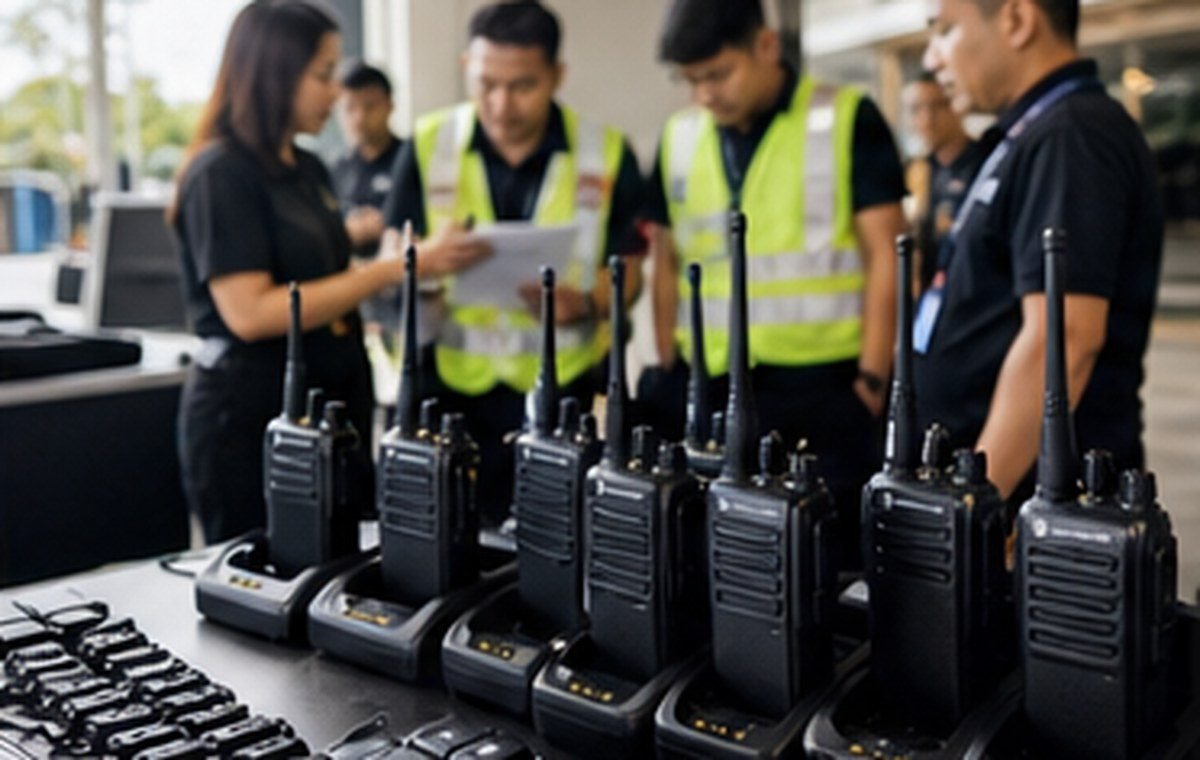
Write the plan on a laminated card and attach it near the charger rack. New staff should not have to ask which channel quality uses. The answer should be visible before the first shift starts.
Device Selection: Rental, Analog, Digital or PoC
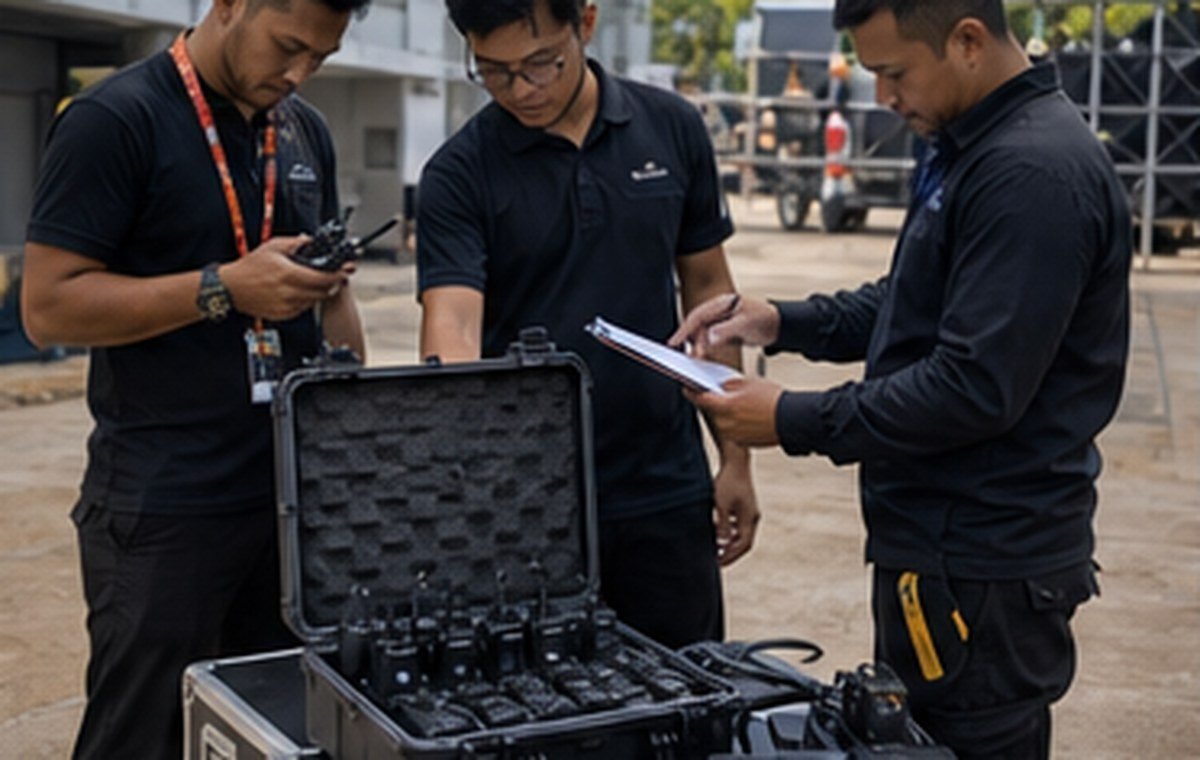
For a short factory shutdown or equipment installation, radio hire at RM 15-35 per unit per day is usually cleaner than buying. The team gets charged batteries, programmed channels and replacement support without managing long-term assets.
Analog UHF (Ultra High Frequency) radios still work for small factories with one floor and fewer than 40 users. Digital DMR (Digital Mobile Radio) fits noisy plants, multi-storey buildings and safety-sensitive teams. PoC (Push-to-Talk over Cellular) radios are better when a headquarters in Kuala Lumpur needs to talk to branch factories in Penang and Johor Bahru.
Before choosing, run a coverage test during production hours. Empty factories are easy. Full factories with moving forklifts, steel racks and running machines are the real test.
| Option | Best fit | Typical use |
|---|---|---|
| Rental | Temporary projects | Shutdowns, audits, short installations |
| Analog UHF (Ultra High Frequency) | Small factory floors | Basic production and warehouse traffic |
| Digital DMR (Digital Mobile Radio) | Noisy or multi-zone sites | Maintenance, safety, private calls |
| PoC (Push-to-Talk over Cellular) radio | Multi-location operations | HQ to branch factory communication |
Real Deployment Notes
Run coverage checks while machines are running, doors are open and forklifts are moving. A quiet Sunday test misses the RF problems that appear on Monday at 10:30.
Use numbered labels and a sign-out sheet. Factories lose radios when everyone assumes the night shift returned them.
Line stop, maintenance needed, copy, standby, all clear and repeat location are more important than long SOP (Standard Operating Procedure) documents.
Common Customer Questions
How many walkie talkie channels does a factory need?
Most small and mid-sized factories can start with 4 to 6 channels: production, maintenance, quality, warehouse, safety and security. Add more only when traffic becomes crowded.
Are walkie talkies better than WhatsApp for production lines?
Yes for urgent production traffic. Walkie talkies broadcast instantly, work with gloves and do not require unlocking a phone. WhatsApp is still useful for photos, documents and non-urgent records.
Should a factory rent or buy walkie talkies?
Rent for shutdowns, audits, temporary lines and installation projects. Buy when the same teams use radios every day for more than 8 to 12 months.
Do factory walkie talkies need MCMC or SIRIM compliance?
Professional radios used in Malaysia should use approved equipment and compliant frequencies. Rental providers such as Octogen can help keep the equipment and channel plan aligned with local requirements.
Can walkie talkies work in noisy manufacturing areas?
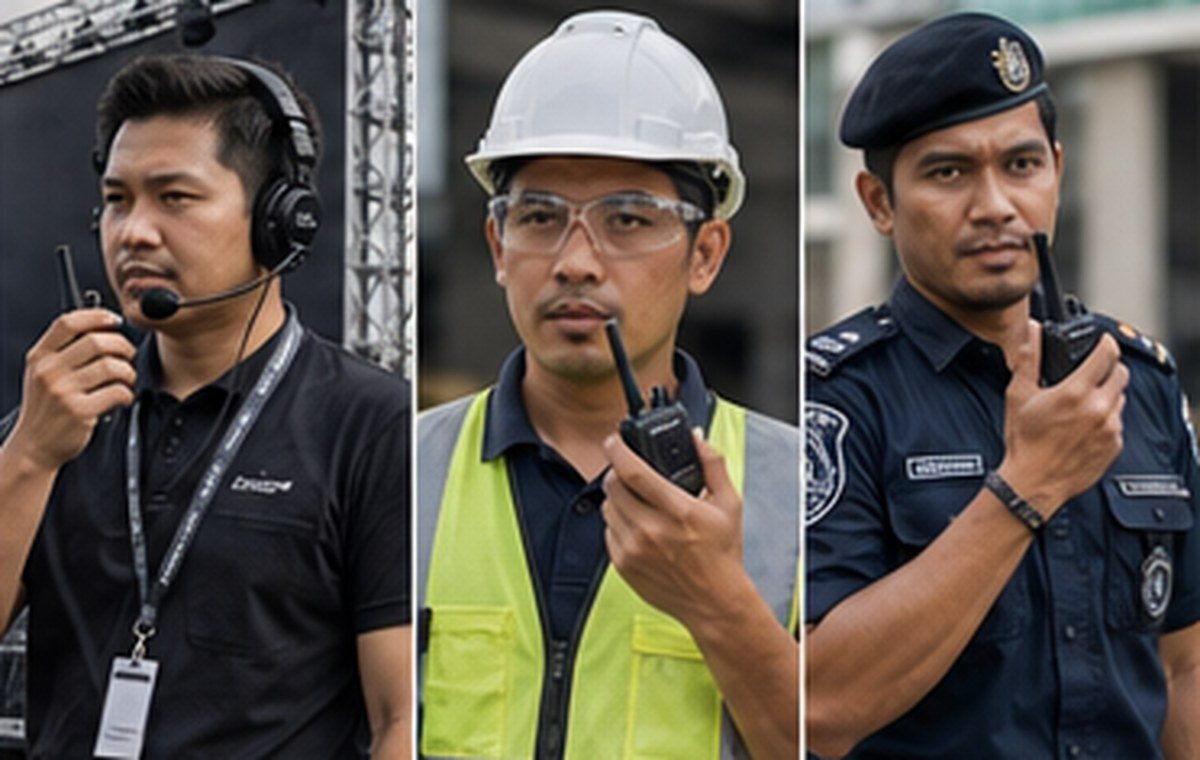
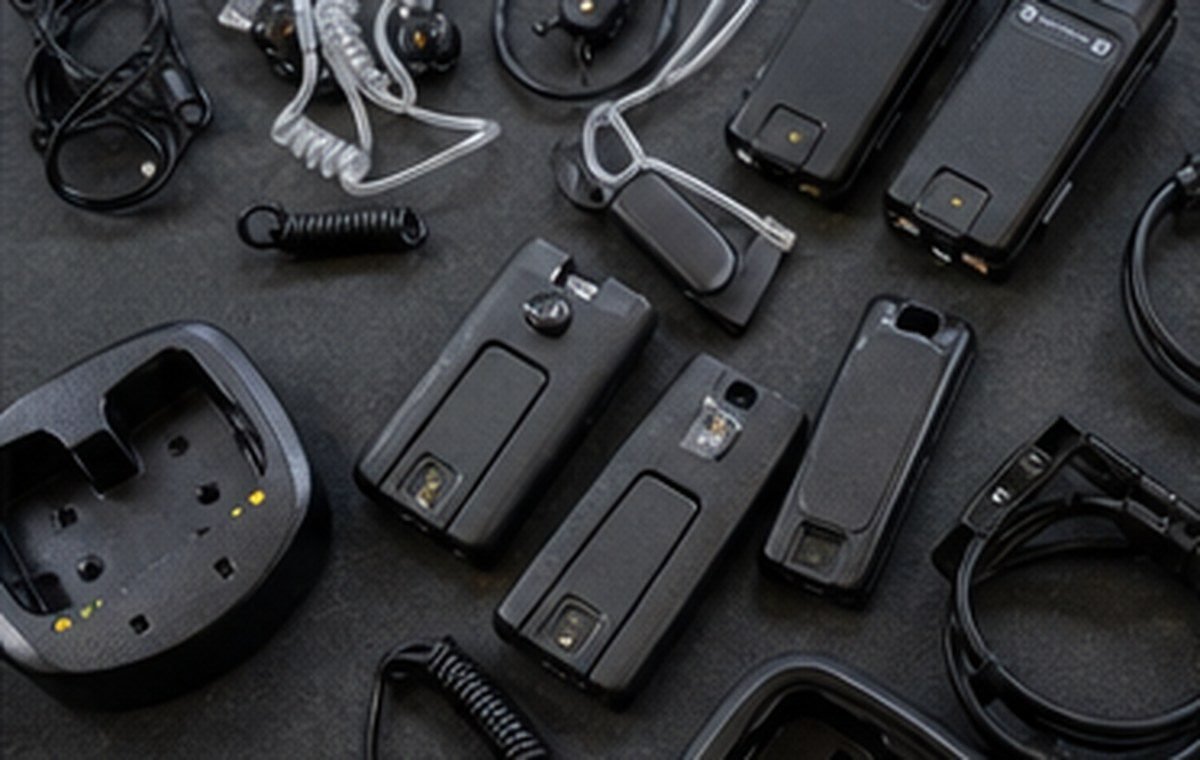
Yes, but choose the right accessories. Speaker microphones, earpieces, noise suppression and clear call protocols are important around stamping, injection moulding and compressor areas.
Ask Octogen About Your Site Coverage
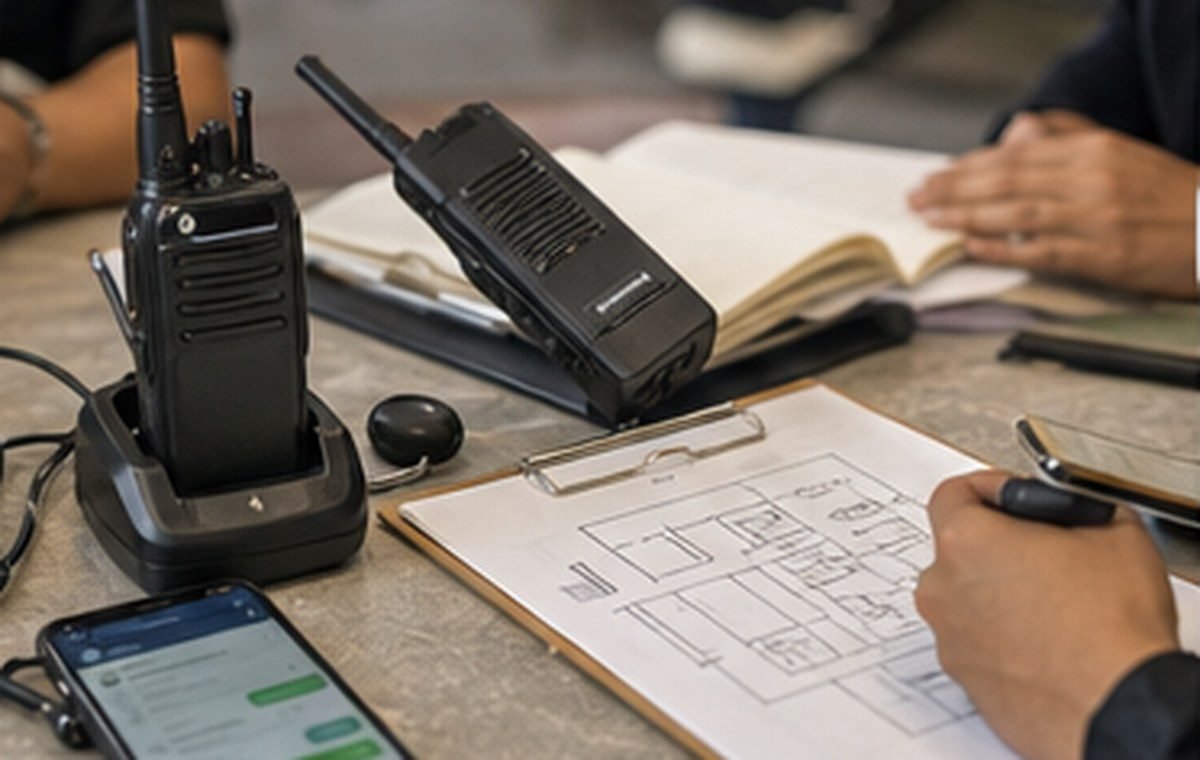
Send Octogen your factory layout, production line count and shift pattern. The team can recommend rental or purchase options, channel plans and accessories for Malaysian manufacturing sites.